
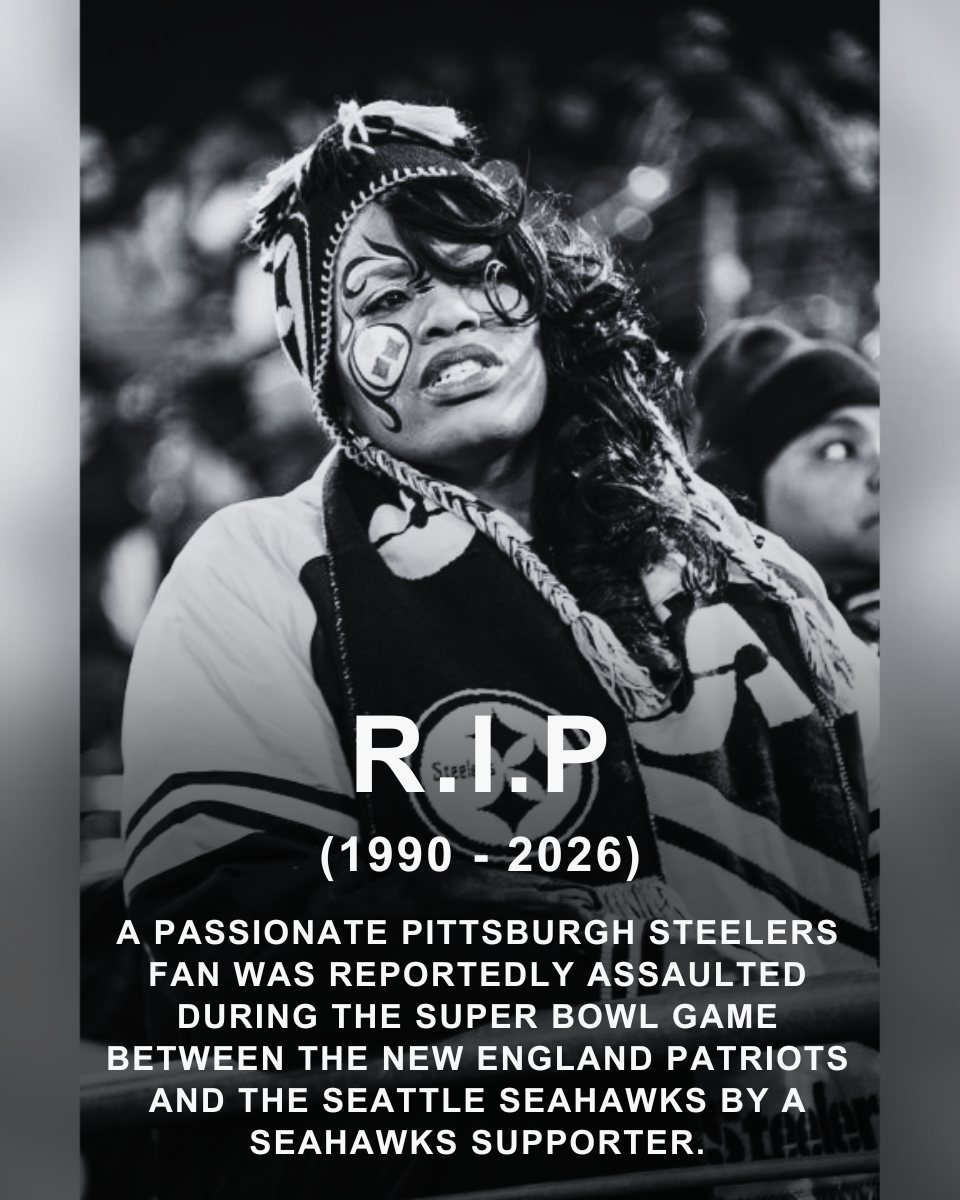
A breaking incident involving an alleged assault between fans during the Super Bowl has ignited a nationwide debate about safety, sports culture, and whether America's most celebrated sporting event is becoming increasingly volatile beneath its glossy, entertainment-driven image.
Reports indicate that a passionate Pittsburgh Steelers supporter was assaulted during the game between the New England Patriots and the Seattle Seahawks, an unexpected confrontation that unfolded amid roaring crowds, flashing cameras, and an atmosphere already charged with emotional intensity.

Authorities confirmed that the victim identified as a Steelers fan was involved in a physical altercation with a Seahawks supporter, triggering immediate intervention from security personnel and raising questions about fan conduct, stadium preparedness, and the emotional stakes surrounding football loyalty.
Witnesses described the moment as sudden and chaotic, with nearby spectators initially assuming the confrontation was a heated argument before realizing it had escalated into something more serious, forcing security teams to respond in front of thousands of stunned onlookers.
Within minutes, clips and commentary began circulating across social media, transforming the incident from a localized conflict into a national conversation about rivalry, aggression, and the thin line between passionate fandom and dangerous confrontation.
Supporters of the victim quickly framed the situation as a failure of crowd management, arguing that Super Bowl environments demand heightened security awareness due to the massive mix of rival fan bases sharing an emotionally charged space.
Others countered that isolated incidents should not define the entire culture of professional football, insisting that millions attend games peacefully every year and that one altercation, while serious, does not reflect the values of the sport's broader community.
The debate intensified as online communities began dissecting every reported detail, with users asking whether alcohol consumption, heightened emotional investment, or long-standing team rivalries contributed to the escalation that led to the alleged assault.
Football analysts noted that fan identity often runs deeper than simple entertainment, representing regional pride, family tradition, and personal loyalty, which can sometimes turn emotionally overwhelming during high-stakes moments like the Super Bowl.
Critics argued that the commercialization and spectacle surrounding the event may unintentionally amplify tensions, transforming games into environments where emotional expression is encouraged, but boundaries are not always clearly reinforced or consistently respected.
Law enforcement officials emphasized that investigations remain ongoing, urging the public to avoid speculation while they review footage, witness accounts, and security reports to determine exactly how the confrontation began and how it escalated so quickly.
Still, the story continues gaining traction because it touches a cultural nerve, exposing how deeply Americans invest in sports not just as entertainment, but as identity, belonging, and emotional release within a shared national ritual.
For Steelers fans, the incident has sparked frustration and concern, with many expressing anger online and demanding stronger protections for attendees regardless of team allegiance, location, or the intensity of rivalry present in the stadium.
Seahawks supporters have also weighed in, with some condemning the alleged violence outright while others caution against assigning blame before investigations conclude, emphasizing that fairness requires waiting for verified facts rather than viral assumptions.
The NFL now faces renewed scrutiny over stadium safety protocols, as critics question whether enough preventative measures exist to identify escalating tensions before they reach the point of physical confrontation in environments packed with tens of thousands of spectators.
Security experts note that large sporting events require constant adaptation, especially as digital culture accelerates emotional reactions and spreads narratives instantly, sometimes intensifying tensions beyond the physical stadium and influencing behavior in real time.
What makes this incident particularly impactful is not only the alleged assault itself, but the symbolism attached to it, unfolding during one of the most watched sporting events in the world where unity, entertainment, and celebration are expected to dominate.
The Super Bowl has long been framed as a national gathering point, bringing together fans of all teams, backgrounds, and beliefs, making moments of conflict stand out more sharply and provoke stronger reactions from audiences both inside and outside football culture.
Psychologists observing sports communities note that shared excitement can sometimes blur personal boundaries, especially when loyalty feels personal, public, and emotionally charged in environments that reward expressive behavior and collective energy.
The story also highlights how quickly narratives form online, as users interpret incomplete information, choose sides, and amplify emotional reactions before official conclusions emerge, often shaping public perception before investigations reach resolution.
Advocates for fan safety argue that moments like this should prompt serious evaluation, not just of security infrastructure, but also of how leagues communicate expectations around behavior, responsibility, and mutual respect among rival supporters.

Some commentators believe the incident could trigger a broader cultural conversation about whether sports organizations should invest more heavily in education campaigns that reinforce the idea that rivalry is meant to energize competition, not justify hostility or aggression.
Others worry the situation may become politicized or exaggerated, as viral storytelling sometimes transforms isolated events into symbols of larger societal breakdowns, regardless of whether the reality matches the intensity of online reaction.
For many viewers, the incident has already shifted how they think about attending major events, raising questions about personal safety, crowd behavior, and whether emotional environments can be managed effectively when millions are watching and reacting simultaneously.
The emotional intensity surrounding football loyalty remains undeniable, and while it often fuels excitement, unity, and unforgettable memories, it also carries the risk of crossing into confrontation when individuals lose sight of the shared humanity behind opposing jerseys.
Stadiums are designed as places of celebration, yet moments like this remind audiences that safety depends not only on security teams, but also on collective responsibility, empathy, and the recognition that rivalry should never eclipse respect.
As investigations continue, the story remains unresolved, but its impact is already clear, sparking conversation across households, workplaces, and digital communities about how sports culture can balance passion with accountability in the modern era.
Whether the incident ultimately proves isolated or symptomatic of broader challenges, it has already reshaped the conversation around what it means to be a fan, how identity is expressed in public spaces, and where the boundaries of rivalry must be drawn.
For the NFL and its global audience, the moment serves as a stark reminder that the world's biggest sporting stage carries not only excitement and spectacle, but also responsibility, as every incident becomes part of a larger narrative about safety and culture.
In the days ahead, attention will likely shift toward official findings, accountability measures, and potential policy adjustments, yet the emotional ripple effect may last longer, influencing how fans think, behave, and engage during future high-stakes games.
Because beyond touchdowns, halftime shows, and championship rings, the Super Bowl remains a cultural mirror, reflecting both the unity and the tension within the communities that gather around it, revealing what happens when passion collides with human unpredictability.